Puchacz
Our second satellite mission. Building on success, reaching for new heights.
Our second satellite mission. Building on success, reaching for new heights.
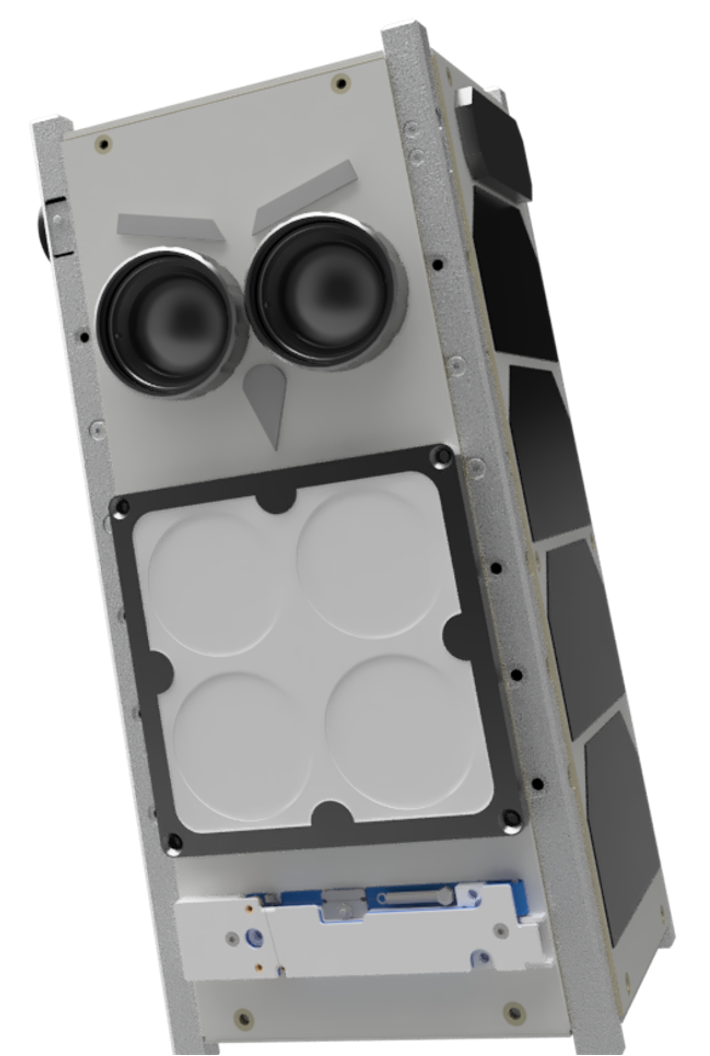
Objective: To demonstrate Earth observation with multispectral imaging, demonstrate optical downlink in orbit, give students hands-on experience with a larger satellite system and provide radio-amateurs society with systems ready to use in future satellite missions.
Following the successful launch of HYPE, we're proud to announce Puchacz - our second satellite mission. This 2U CubeSat represents a significant step forward in our mission to advance Polish space technologies.
Building on the experience and lessons learned from HYPE, Puchacz will carry more advanced payloads and test cutting-edge technologies that push the boundaries of what student-built satellites can achieve.
Puchacz represents a new chapter in SatLab AGH's journey. With a larger form factor and advanced payloads, this mission aims to:
This mission proves that through passion, knowledge and collaboration, we can reach for the stars and make significant contributions to radio-amateurs society and space technology!
Puchacz carries two advanced cameras for comprehensive Earth observation:
These imaging systems will enable scientific research and contribute to Earth observation capabilities from space.
DZIDA is a compact wide-beam optical communication transmitter flying on Puchacz. The 0.25U payload demonstrates an in-house proof-of-concept laser downlink: an infrared high-peak-power pulsed diode driven by a radiation-hardened FPGA delivers efficient transmission with low average power. Wide-beam design relaxes ADCS pointing requirements and keeps satellite-side cost down, paving the way for robust, energy-efficient optical links on future small satellite missions.
BEAR investigates radiation shielding performance of bio-composite materials in Low Earth Orbit (LEO) using a matrix of 12 passive RADFET dosimeters beneath multiple protective layers.
Orbital data analysis will evaluate material attenuation, LEO exposure variability, and environmental factors (orbital position and solar activity), supporting development of lightweight, bio-based shielding for long-duration human missions.
As part of our mission we are planning to provide the future Radio-Amateurs satellite missions with ready-to-go solutions in hardware and software, by publishing our:
Those objectives will contribute to providing a ready-to-go framework for future amateur satellite missions.